We independently research every product mentioned on this page, drawing on real owner reviews, product specs, and vet-reviewed sources. If you buy through a link here, Catverdict may earn a small commission — this never affects our picks or costs you anything extra. Details in our affiliate disclosure.
Bottom line: An automatic feeder helps keep mealtimes consistent, which matters for cats prone to overeating or for households with irregular schedules. For most owners, an app-controlled feeder with portion scheduling is the best all-around pick. Multi-cat homes should look at microchip-recognition feeders so each cat only gets its own food.
This guide is for owners who want consistent, portion-controlled feeding — whether that’s for weight management, a multi-cat household, or just covering mealtimes when you’re away.
Curious how we evaluate and rank every pick on this page? See our How We Choose Our Picks.
Jump to a section
At-a-Glance Comparison: Best Automatic Cat Feeder
| Pick | Best For | Key Feature |
|---|---|---|
| Best Overall | Most households | App control, portion scheduling |
| Best for Multiple Cats | 3+ cats, dry food | Large-capacity hopper |
| Best Microchip | Cats on different diets | Per-cat recognition |
| Best for Wet Food | Wet or fresh food meals | Ice pack cooling compartment |
| Best Budget | Simple scheduled feeding | Gravity/timer, no app needed |
Buyer’s Guide: Choosing the Right Automatic Cat Feeder
How We Chose These Feeders
We built this list around four practical criteria: portion accuracy and scheduling flexibility, hopper capacity relative to household size, food compatibility (dry vs. wet), and ease of cleaning. None of these were purchased and tested in-house — this is a selection built from product specs, materials, and owner feedback patterns, not hands-on testing.
App-Controlled vs. Gravity vs. Timer-Only
App-controlled feeders let you set multiple meals, portion sizes, and get notifications when your cat eats — useful if you travel or keep irregular hours. Timer-only feeders cover the basics (scheduled portions) without a subscription or app dependency, a reasonable middle ground. Gravity feeders simply keep a bowl topped off as your cat eats — the cheapest and simplest option, but they offer no portion control, which isn’t ideal for cats prone to overeating.
Multi-Cat Households and Microchip Recognition
If your cats are on different diets (one needs weight management food, another doesn’t) or one tends to steal the other’s meals, a microchip or RFID-collar feeder opens only for the registered cat. For households where all cats eat the same food in similar amounts, a simple large-capacity feeder is usually enough.
Top 5 Automatic Cat Feeder Reviews
#1 Best Overall: App-Controlled Feeder
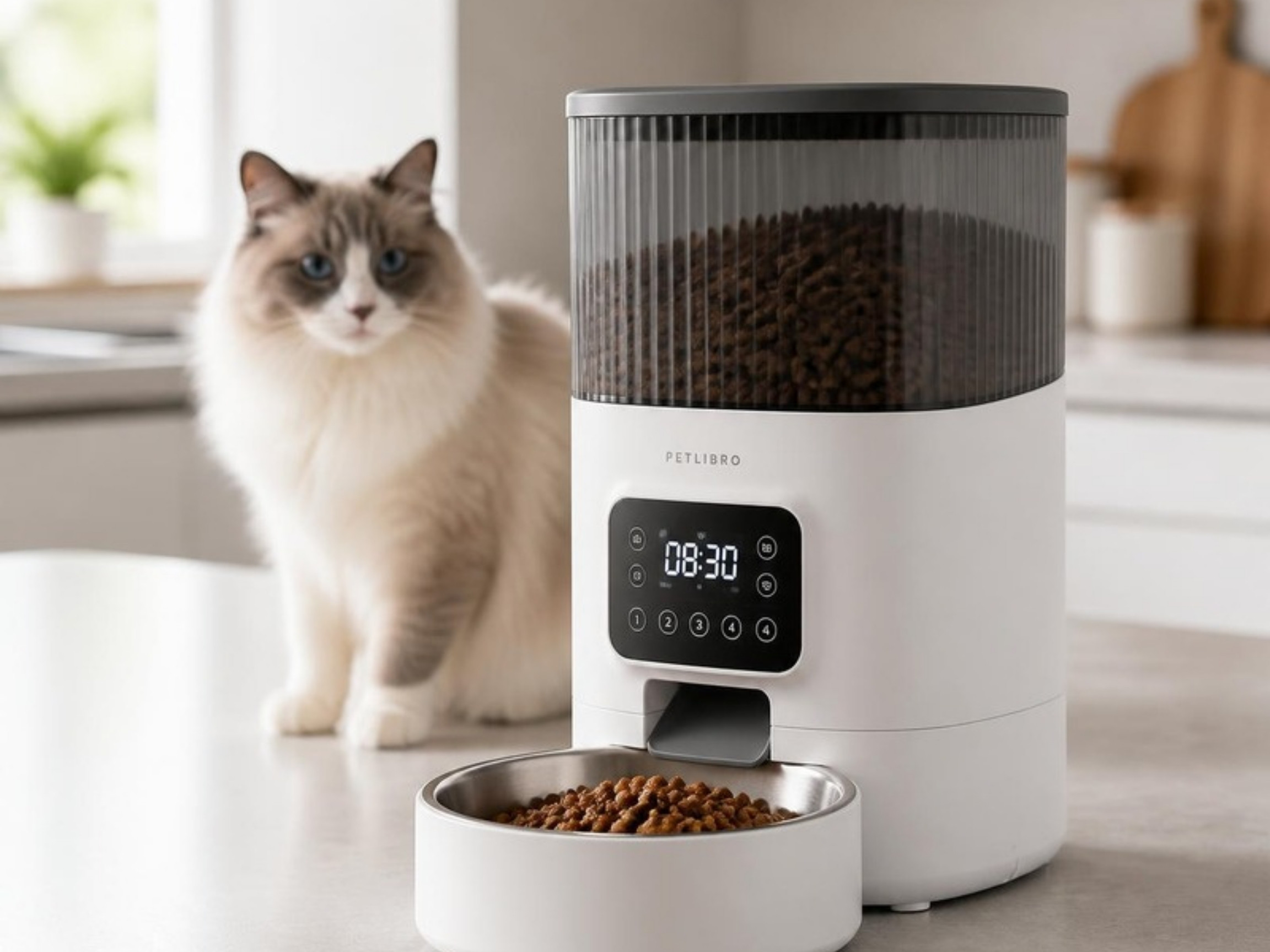
Why it’s a good fit: App control lets you set multiple scheduled meals, adjust portion sizes remotely, and get an alert if your cat skips a meal — useful for catching early signs of illness. It covers the widest range of use cases of any feeder type.
- App scheduling & notifications
- Adjustable portion sizes
- Battery backup (most models)
Pros
- Flexible scheduling from your phone, even away from home
- Eating-pattern alerts can flag early health concerns
- Battery backup keeps meals on schedule during outages
Cons
- Relies on Wi-Fi for remote features
- Pricier than timer-only or gravity models
Who should NOT buy this: Skip if you just want a simple, no-app timer — the budget gravity pick below is simpler to set up.
Our Analysis
For most households, the flexibility of app control outweighs the extra cost — being able to adjust a meal time or portion remotely, or get notified when a cat skips a meal, is the main reason we’d recommend this over a basic timer feeder.
#2 Best for Multiple Cats: Large-Capacity Feeder
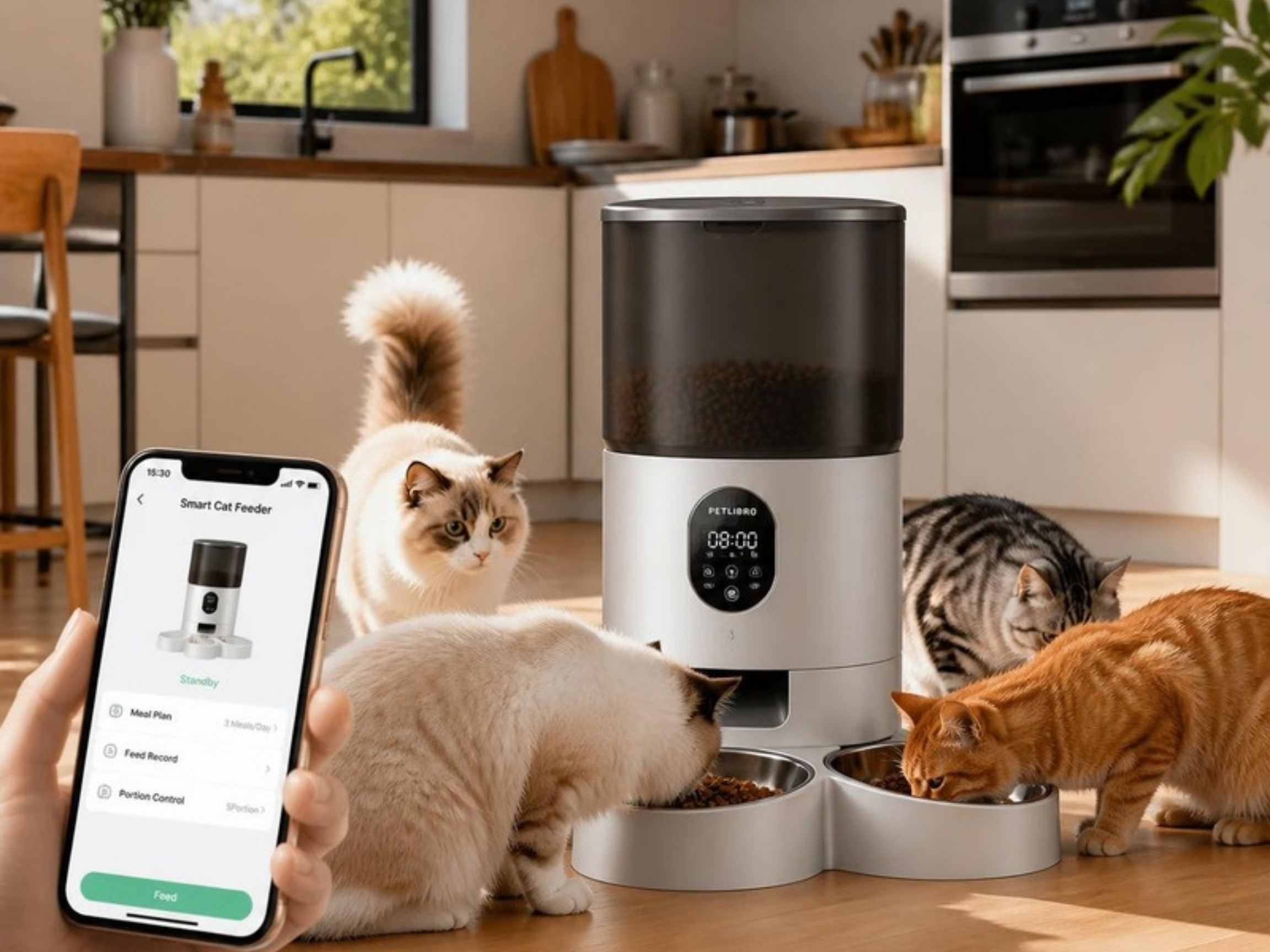
Why it’s a good fit: A large hopper (10L+) means fewer refills in a multi-cat household eating the same food, and app scheduling lets you stagger meal times across several feeding points if needed.
- Capacity: 10L+ dry food
- App scheduling
- Desiccant bag slot (keeps kibble fresh)
Pros
- Fewer refills, even feeding several cats
- Desiccant slot helps kibble stay fresh longer
- Still offers app scheduling and portion control
Cons
- Large footprint — needs counter or floor space
- Doesn’t distinguish between individual cats (see microchip pick below for that)
Who should NOT buy this: Skip if your cats need different diets or portions — the microchip-recognition pick below handles that better.
Our Analysis
If all your cats eat the same food in similar amounts, this is simpler and cheaper than a microchip feeder — reserve the extra cost of per-cat recognition for households where diets actually differ.
#3 Best for Different Diets: Microchip Feeder
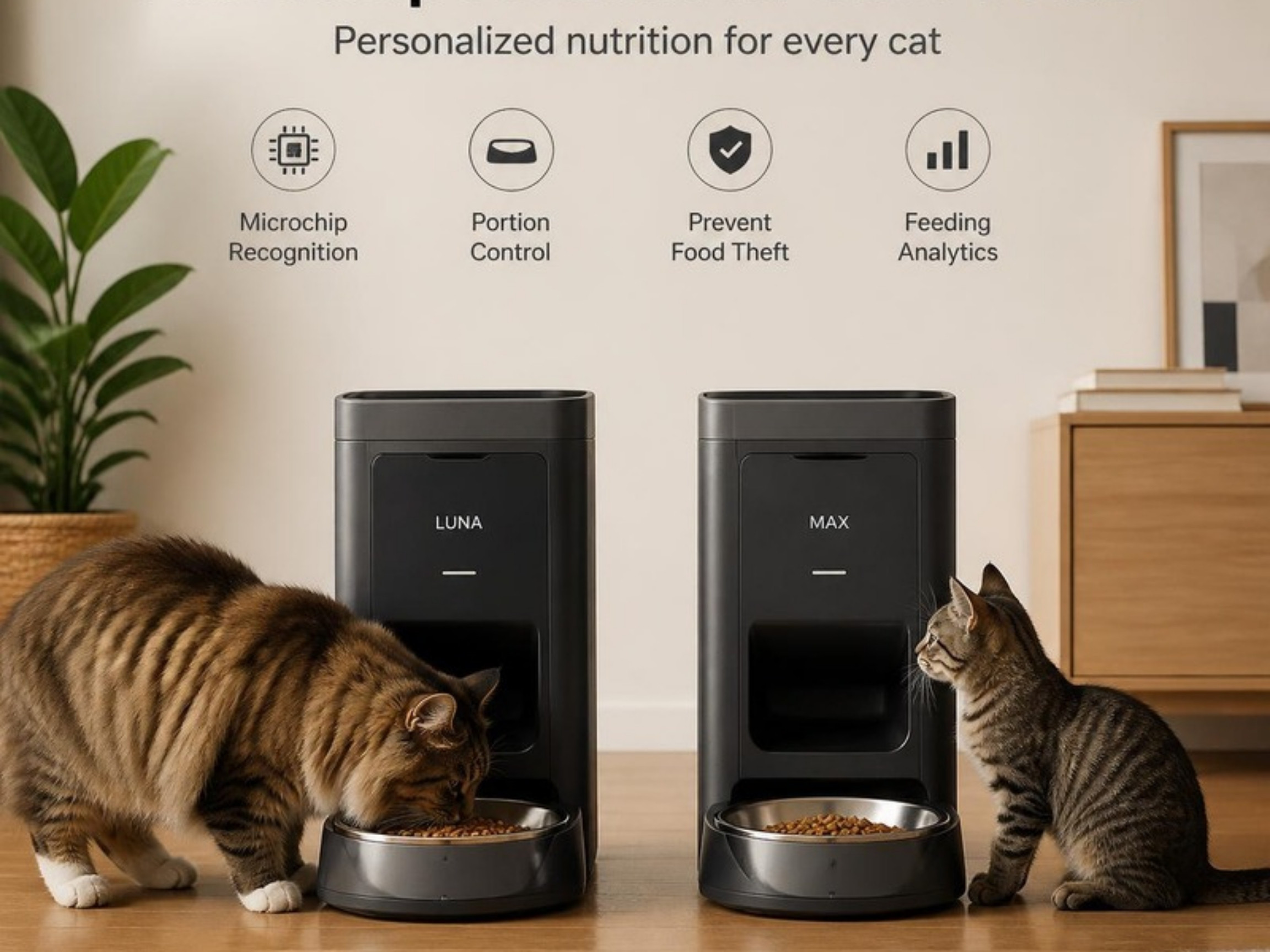
Why it’s a good fit: Microchip or RFID-collar recognition means the feeder only opens for the registered cat, which is the practical solution when one cat needs a prescription or weight-management diet and another doesn’t — or when one cat tends to steal the other’s food.
- Microchip/RFID recognition
- Anti-tamper lid
- Portion control per cat
Pros
- Prevents food-stealing between cats
- Enables separate diets or portions per cat
- Anti-tamper lid keeps determined cats out between meals
Cons
- Requires registering each cat’s chip or collar tag
- Costs more than a standard single-cat feeder
Who should NOT buy this: Skip if you have one cat, or multiple cats on identical diets — the large-capacity pick above is simpler and cheaper.
Our Analysis
This is worth the extra cost specifically when diets differ between cats — for same-diet multi-cat households, it’s an unnecessary expense compared to our large-capacity pick above.

#4 Best for Wet Food: Cooling Compartment Feeder
Why it’s a good fit: Most automatic feeders are built for dry kibble, but wet food spoils fast at room temperature. An ice-pack or built-in cooling compartment keeps portioned wet food safe to eat for several hours before a scheduled release.
- Ice pack cooling compartment
- Portioned wet or fresh food trays
- Scheduled release timer
Pros
- Keeps wet or fresh food safe to eat longer before release
- Good option for cats on a wet-food-only diet
- Portioned trays reduce mess compared to open bowls
Cons
- Trays and cooling compartment need regular washing
- Smaller total capacity than dry-food hoppers
Who should NOT buy this: Skip if your cat eats only dry kibble — a standard app-controlled or large-capacity feeder is simpler and cheaper for that.
Our Analysis
If wet food is part of your cat’s regular diet, this solves a real gap most automatic feeders don’t address — just plan on washing the trays daily, since wet food residue spoils and smells faster than kibble.
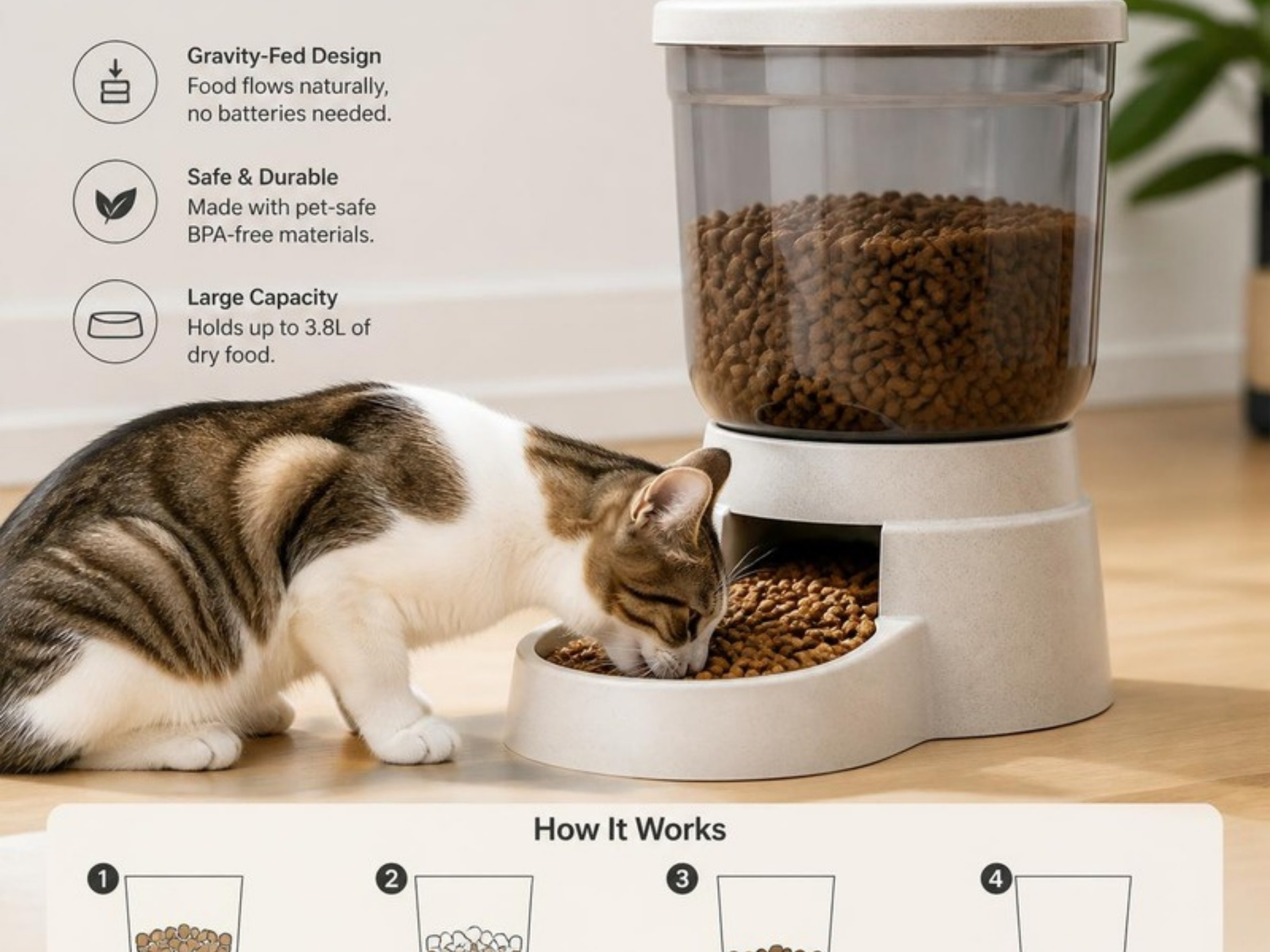
#5 Best Budget: Gravity Feeder
Why it’s a good fit: If you just need a backup bowl that stays topped off — for a weekend away or a cat that doesn’t overeat — a simple gravity feeder covers it without an app, Wi-Fi, or batteries.
- No batteries or app required
- Gravity-fed, keeps bowl topped off
- Lowest-cost pick
Pros
- Lowest-cost way to automate feeding
- No setup, app, or Wi-Fi needed
- Works during power outages with no battery backup required
Cons
- No real portion control — not ideal for cats that overeat
- No scheduling or remote monitoring
Who should NOT buy this: Skip if your cat needs portion control for weight management — the app-controlled pick above gives you that, this doesn’t.
Our Analysis
Treat this as a convenience backup rather than a primary feeding solution for cats prone to overeating — it’s best suited to a cat with good self-regulation, or as a short-trip backup alongside a scheduled feeder.
Frequently Asked Questions
How do I transition my cat to an automatic feeder?
Start by running the feeder alongside your cat’s normal bowl for a few days so they learn the sound and motion aren’t a threat. Then gradually shift meals fully onto the schedule. Most cats adjust within a week.
Can automatic feeders dispense wet food?
Most standard automatic feeders are designed for dry kibble only. If your cat eats wet or fresh food, look specifically for a feeder with a cooling compartment (see our wet food pick above) — standard hoppers will jam or spoil wet food.
What happens if the power goes out?
Most app-controlled and large-capacity feeders include a battery backup that keeps the schedule running through a power outage. Gravity feeders aren’t affected by power at all, since they have no electronics. Always check a specific model’s battery backup before relying on it while you’re away.
How many cats can share one automatic feeder?
A standard large-capacity feeder works fine for multiple cats eating the same food in similar amounts. If your cats need different diets or portions, or one tends to steal the other’s food, a microchip-recognition feeder (see our pick above) is the better fit.
Looking for more essentials? Check out our full Best Cat Toys & Gear hub for fountains, trackers, and other everyday gear.
Research Disclaimer: This content was compiled from manufacturer specs, retailer listings, and owner-review patterns for informational purposes only — products on this page were not purchased or tested in-house. If your cat’s eating habits change suddenly (eating much more or much less, or losing interest in food), that can be a sign of an underlying health issue — check with your veterinarian rather than relying on a new feeder to fix it.