
We independently research every product on this page, drawing on publicly available specs and owner reviews. If you buy through a link here, Catverdict may earn a small commission — this never affects our picks or costs you anything extra. Details in our affiliate disclosure.
Bottom line: A cat litter deodorizer doesn’t replace regular scooping, but a baking-soda powder mixed into the litter is the cheapest, most reliable way to cut ammonia smell between full litter changes. Charcoal-based options go a step further for persistent odor, and a box-level spray helps with the surrounding air rather than the litter itself.
Curious how we evaluate and rank every pick on this page? See our How We Choose Our Picks.
Jump to a section
At-a-Glance Comparison: Best Cat Litter Deodorizers
| Pick | Best For | Scented? |
|---|---|---|
| Baking Soda Additive | Everyday odor control, budget pick | Usually unscented |
| Activated Charcoal | Stronger, persistent odor | Usually unscented |
| Area Spray | Odor in the room, not the box itself | Often lightly scented |
| Pine/Herbal Additive | Owners who prefer a natural scent boost | Naturally scented |
| Probiotic Powder | Sensitive cats, scent-free households | Unscented |
Buyer’s Guide: Choosing a Cat Litter Deodorizer
How We Chose These Options
We compared litter deodorizers on how they actually work (absorption vs. masking scent), whether cats tend to tolerate the scent or texture, and how they fit into a normal scooping routine. This is a selection built from published ingredients and owner reviews, not an in-house trial.
Deodorizer vs. Just Scooping More Often
No deodorizer replaces regular scooping — ammonia smell comes primarily from urine breaking down over time, so the most effective single step is still scooping daily and doing a full litter change on schedule. A deodorizer is a helpful add-on for the odor that builds up between those steps, not a substitute for them.
Watch for Scent Sensitivity
Some cats are sensitive to strongly scented litter additives and may avoid the box if the smell is too strong to them — cats have a much more sensitive sense of smell than humans. If you’re introducing a scented product for the first time, watch your cat’s litter box habits closely for the first week and switch to an unscented option if you notice avoidance.
Top 5 Cat Litter Deodorizers
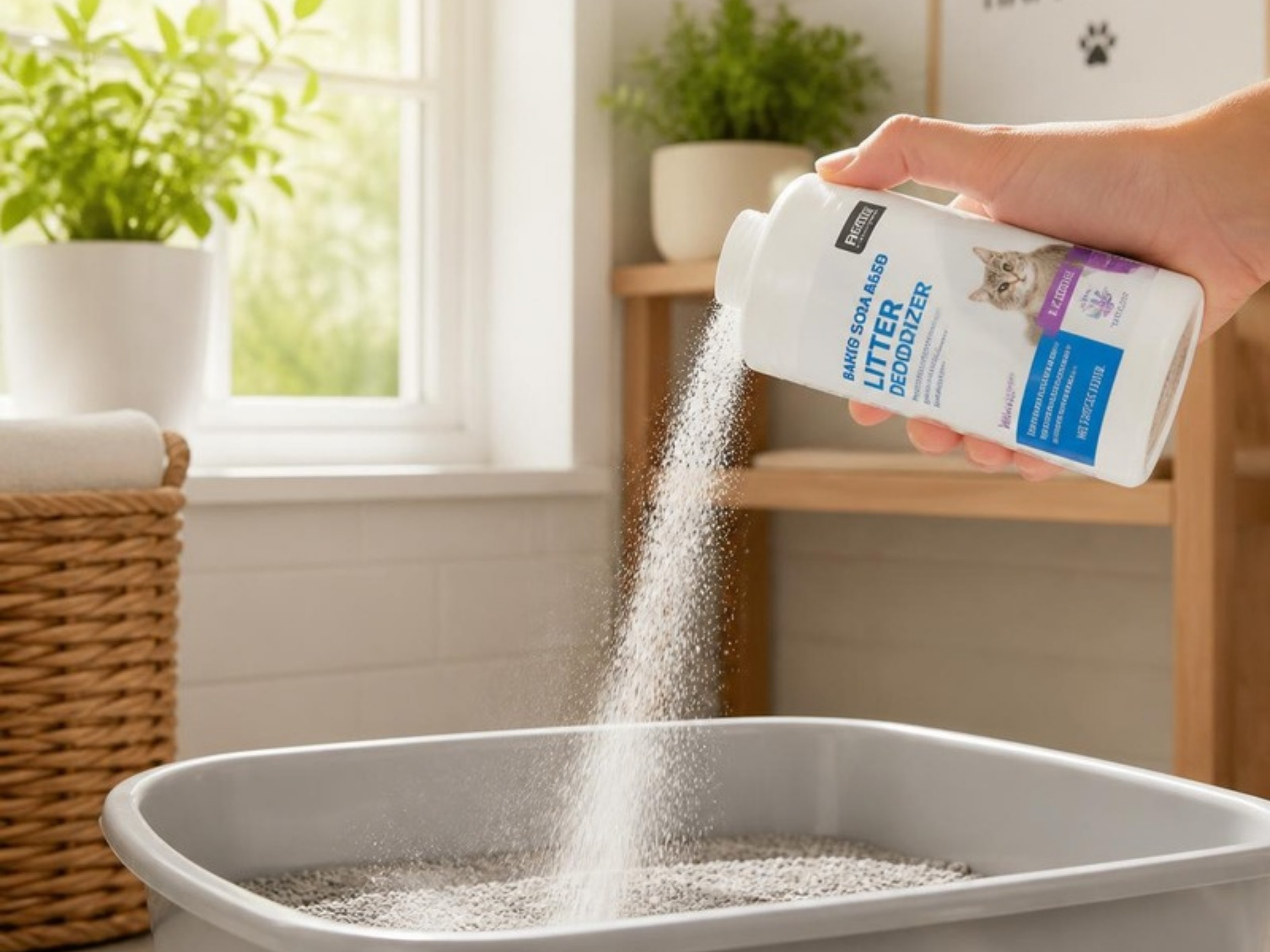
#1 Best Overall: Baking Soda Litter Additive
Why it’s a good fit: A baking-soda-based additive neutralizes ammonia odor at the source rather than masking it, works with any litter type, and is usually unscented — the safest starting point for most households, including multi-cat homes with sensitive cats.
- Works with any litter type
- Usually unscented
- Low cost per use
Pros
- Neutralizes odor rather than covering it up
- Unscented options widely available
- Inexpensive and long-lasting per container
Cons
- Needs reapplying with each full litter change
- Less effective on its own for very strong, established odor
Who should NOT use this: Skip if your litter box odor problem is really about infrequent scooping — a deodorizer won’t fix an underlying maintenance gap.
Our Analysis
Because it’s unscented and works through odor-neutralizing chemistry rather than fragrance, baking soda additive is the lowest-risk starting point for cats sensitive to scent, and it’s cheap enough to try without much downside.

#2 Best for Strong Odor: Activated Charcoal Additive
Why it’s a good fit: Activated charcoal has a larger surface area for trapping odor molecules than baking soda, making it a step up for multi-cat households or litter boxes in small, enclosed spaces where smell builds up fast.
- Stronger odor absorption than baking soda alone
- Usually unscented
- Good for enclosed or covered boxes
Pros
- Handles stronger, more persistent odor than baking soda
- Works well in covered or enclosed litter boxes
- Typically unscented
Cons
- Usually costs more per use than baking soda
- Dark granules can be visible against light-colored litter
Who should NOT use this: Skip if a basic baking soda additive is already handling your odor fine — there’s no need for the stronger (and pricier) option.
Our Analysis
Charcoal is worth the step up specifically for enclosed litter boxes or multi-cat homes where odor tends to concentrate — for a single cat in an open box, baking soda alone is usually enough.

#3 Best for the Surrounding Room: Litter Box Area Spray
Why it’s a good fit: An area spray is meant for the room around the litter box, not the litter itself — useful if odor lingers in a small bathroom or laundry room even when the box itself is clean. It’s a complement to a litter additive, not a replacement for one.
- For room air, not the litter box directly
- Often lightly scented
- Quick, no-mess application
Pros
- Fast fix for a lingering-smell room, not just the box
- No mixing into litter required
- Pet-safe formulas widely available
Cons
- Masks odor rather than addressing its source in the litter
- Scented versions may bother odor-sensitive cats if sprayed too close to the box
Who should NOT use this: Skip as your only odor solution — pair it with a litter additive rather than relying on a room spray alone.
Our Analysis
Area sprays solve a different problem than litter additives — they’re for the room, not the box — so the best setup usually pairs one with a baking soda or charcoal additive rather than choosing between them.

#4 Best Natural Option: Pine or Herbal Additive
Why it’s a good fit: For owners who want a natural scent boost rather than an unscented neutralizer, pine- or herb-based additives (often using essential oil-free natural extracts) offer a gentler alternative to synthetic fragrance.
- Naturally scented, not synthetic fragrance
- Plant-based ingredients
- Lighter scent profile than most sprays
Pros
- Natural ingredients appeal to owners avoiding synthetic fragrance
- Generally gentler scent than commercial sprays
- Works alongside most litter types
Cons
- Still a scent, which some cats won’t tolerate
- Generally weaker odor absorption than charcoal
Who should NOT use this: Skip if your cat has shown any scent sensitivity before — go with an unscented baking soda or charcoal option instead.
Our Analysis
This is more of a preference pick than a performance upgrade — choose it if you specifically want a natural scent in the litter area, not because it outperforms baking soda or charcoal on odor control.

#5 Best for Sensitive Cats: Probiotic Odor Control Powder
Why it’s a good fit: Probiotic-based powders use beneficial bacteria to break down odor-causing compounds rather than fragrance or absorption alone, making them a good fit for scent-free households or cats that react poorly to both scented and mineral-based additives.
- Unscented, bacteria-based odor breakdown
- Good for scent-sensitive cats
- Works gradually rather than instantly
Pros
- Completely unscented approach
- Breaks down odor-causing compounds rather than masking them
- Good fit for households avoiding all fragrance
Cons
- Slower-acting than baking soda or charcoal
- Less widely available than other options
Who should NOT use this: Skip if you need a fast fix for existing strong odor — this works best as an ongoing, preventive approach rather than an immediate solution.
Our Analysis
This is the most niche pick on the list, but a reasonable choice specifically for households that have ruled out both scented and mineral-based additives due to cat sensitivity.
Frequently Asked Questions
Will a deodorizer stop me from having to scoop as often?
No — a deodorizer only helps with the smell between scooping, not the clumps or waste itself. Daily scooping is still the main driver of a clean-smelling litter box.
Can I just use regular baking soda from the kitchen?
Plain baking soda works similarly to a commercial litter additive, though pet-specific products are formulated for the right concentration and sometimes include added ingredients for extra absorption. Either approach is reasonable for most households.
My cat avoided the litter box after I added a deodorizer — what happened?
This usually points to scent or texture sensitivity. Remove the additive, clean the box thoroughly, and if you want to try again, start with a small amount of an unscented option rather than a strongly fragranced one.
Still dealing with odor even with a deodorizer? See our best cat litter guide — the litter itself matters more than any additive.
Research Disclaimer: This article is for informational purposes and was researched using publicly available product information and owner reviews — it was not written by a veterinarian, and no products listed here were used in-house for this comparison. If your cat suddenly avoids the litter box, that’s worth mentioning to your vet, since it can signal a medical issue rather than an odor preference.