We independently research every product we recommend, drawing on real owner reviews, product specs, and vet-reviewed sources. If you buy through a link on this page, Catverdict may earn a small commission — this never affects our picks or costs you anything extra. Details in our affiliate disclosure.
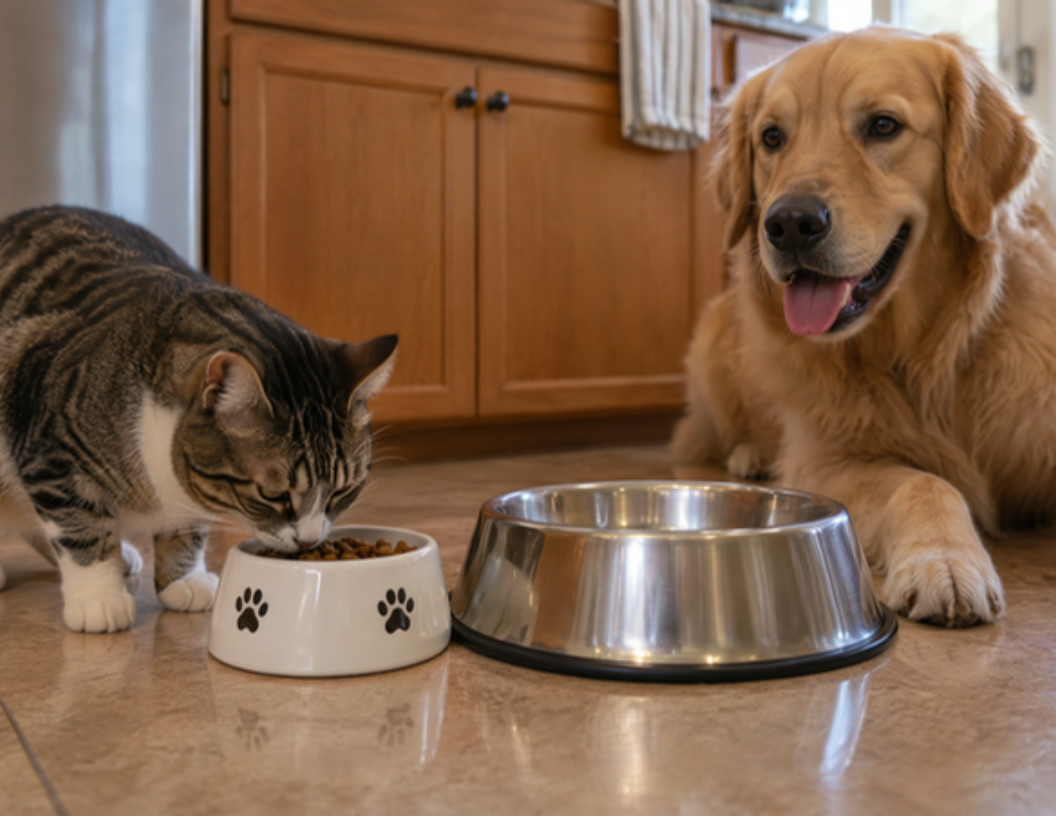
Caught your cat sneaking a mouthful from the dog’s bowl? What happens if a cat eats dog food depends entirely on how much and how often. A stolen bite here and there won’t harm a healthy cat, but dog food isn’t built for feline nutrition — and a cat that’s regularly eating it instead of cat food can run into real deficiencies over time. Here’s what’s actually going on nutritionally, and when it’s worth stepping in.
Table of Contents
| One accidental bite? | Not dangerous for a healthy adult cat |
| Regular diet of dog food? | Can cause real nutritional deficiencies over weeks to months |
| Is it toxic? | No — it’s a nutritional mismatch, not a poisoning risk |
The Quick Answer
An occasional bite of dog food won’t hurt a healthy cat — it’s not toxic or dangerous the way certain human foods are. The real issue only shows up if a cat eats dog food regularly instead of cat food, because dog food is formulated for a completely different set of nutritional needs and is missing several nutrients cats can’t produce on their own.
Why Dog Food Isn’t Built for Cats
Cats are obligate carnivores with nutritional requirements dogs simply don’t share. Dog food is formulated around a more omnivorous diet, with lower protein and fat levels than cats need, and it’s missing or under-dosed in several nutrients that are essential specifically for cats, including:
- Taurine: an amino acid cats can’t synthesize in adequate amounts themselves; dogs can, so dog food isn’t fortified with the levels cats require.
- Arachidonic acid: an essential fatty acid cats must get from their diet; dogs can produce their own.
- Vitamin A: cats can’t convert plant-based beta-carotene into usable vitamin A the way dogs can, so they need it pre-formed from animal sources.
- Higher protein and fat overall: cat food is formulated with significantly more animal protein than most dog food.
One Bite vs. a Regular Diet
Context matters a lot here. A cat stealing a few kibbles from the dog’s bowl occasionally is a non-issue — it won’t cause a taurine deficiency or any other problem from a single meal or two. The concern is strictly about a cat eating dog food as a regular or primary part of its diet over an extended period, which is when the missing nutrients actually have time to add up to a real deficiency.
What Long-Term Dog Food Feeding Can Cause
If a cat ate little else but dog food for an extended period, the most well-documented risk is taurine deficiency, which can lead to a serious heart condition called dilated cardiomyopathy, as well as vision problems, since taurine is also important for feline eye health. Chronically low protein and fat intake relative to a cat’s needs can also show up as poor coat condition, muscle loss, and low energy over time. These are gradual, cumulative effects — not something that happens from a one-off bowl swap — but they’re a real reason not to let dog food become a cat’s regular diet.
[PRODUCT: high-protein, taurine-fortified cat food — keeps a cat’s actual diet nutritionally complete, especially useful in multi-pet households | PLATFORM: Amazon]
How to Stop a Cat From Eating the Dog’s Food
The simplest fix in most multi-pet homes is separating feeding areas and timing:
- Feed in separate rooms: close a door or use a baby gate so each pet only has access to its own bowl.
- Elevate the cat’s food: cats can usually jump up to a counter or shelf a dog can’t reach, which keeps the cat’s bowl exclusive.
- Pick up bowls after mealtime: don’t leave either food out to free-feed if cross-eating keeps happening.
- Use a microchip or timed feeder: for persistent cross-eating, a feeder that only opens for one pet’s chip or schedule solves it for good.
[PRODUCT: microchip pet feeder — opens only for the registered pet, a reliable fix when a cat and dog keep swapping bowls | PLATFORM: Amazon]
Frequently Asked Questions
Is dog food toxic to cats?
No. Dog food isn’t toxic or poisonous to cats — the issue is a nutritional mismatch over time, not an acute danger from eating it occasionally.
Can kittens eat dog food?
An occasional bite isn’t an emergency, but kittens have even higher protein and nutrient needs than adult cats for proper growth, so dog food should never replace kitten food as a regular diet.
What if my cat prefers the dog’s food?
Separate the feeding areas rather than letting the preference continue — a cat’s “preference” for dog food is usually about access or palatability, not a nutritional need, and it shouldn’t replace a complete cat food.