We independently research every product we recommend, drawing on real owner reviews, product specs, and vet-reviewed sources. If you buy through a link on this page, we may earn an affiliate commission at no extra cost to you.
“Grey cat” isn’t a single breed — it’s a coat color (often called “blue” by cat registries) that shows up across dozens of different breeds, from the Russian Blue to an ordinary domestic shorthair. Some grey cats are also tabbies, which adds a whole second layer to the question. Here’s what actually makes a cat grey, which breeds are grey by default, and how to tell a “grey tabby” apart from a solid-grey cat.
Grey Cat Overview
| Coat Color Name | “Grey” in common use; “blue” in official registry standards |
| Caused By | A dilution gene that lightens black pigment to a blue-grey shade |
| Naturally Grey Breeds | Russian Blue, Chartreux, Korat, British Shorthair (blue), Nebelung |
| Also Common In | Domestic shorthair/longhair (“grey tabby”) |
| Lifespan | 12–17 years (varies by breed) |
| Typical Price | $0–$50 (shelter) to $1,000–$2,000+ (purebred, e.g. Russian Blue, Chartreux) |
What Makes a Cat Grey? (The Genetics)
Cat registries don’t actually use the word “grey” — they call this color blue. It isn’t a separate pigment; it’s black pigment (eumelanin) that has been diluted. A recessive “dilute” gene (symbol d) spreads the black pigment granules more unevenly along each hair shaft, which scatters light differently and reads to the eye as a soft blue-grey instead of jet black. A cat needs two copies of the dilute gene (one from each parent) to show the grey/blue color — a cat with only one copy stays black but can still pass the gene to kittens.
This is the same dilution mechanism that turns orange into cream — it just starts from a different base pigment. If a cat is grey rather than cream, its underlying “default” color (before dilution) would have been black rather than orange/red.
Grey Tabby vs. Solid Grey
Plenty of searches for “grey cat” are really about a grey tabby — a cat with the tabby patterning gene (stripes, spots, or swirls) sitting on top of a diluted black base color, rather than a solid, pattern-free grey coat. The two look different up close:
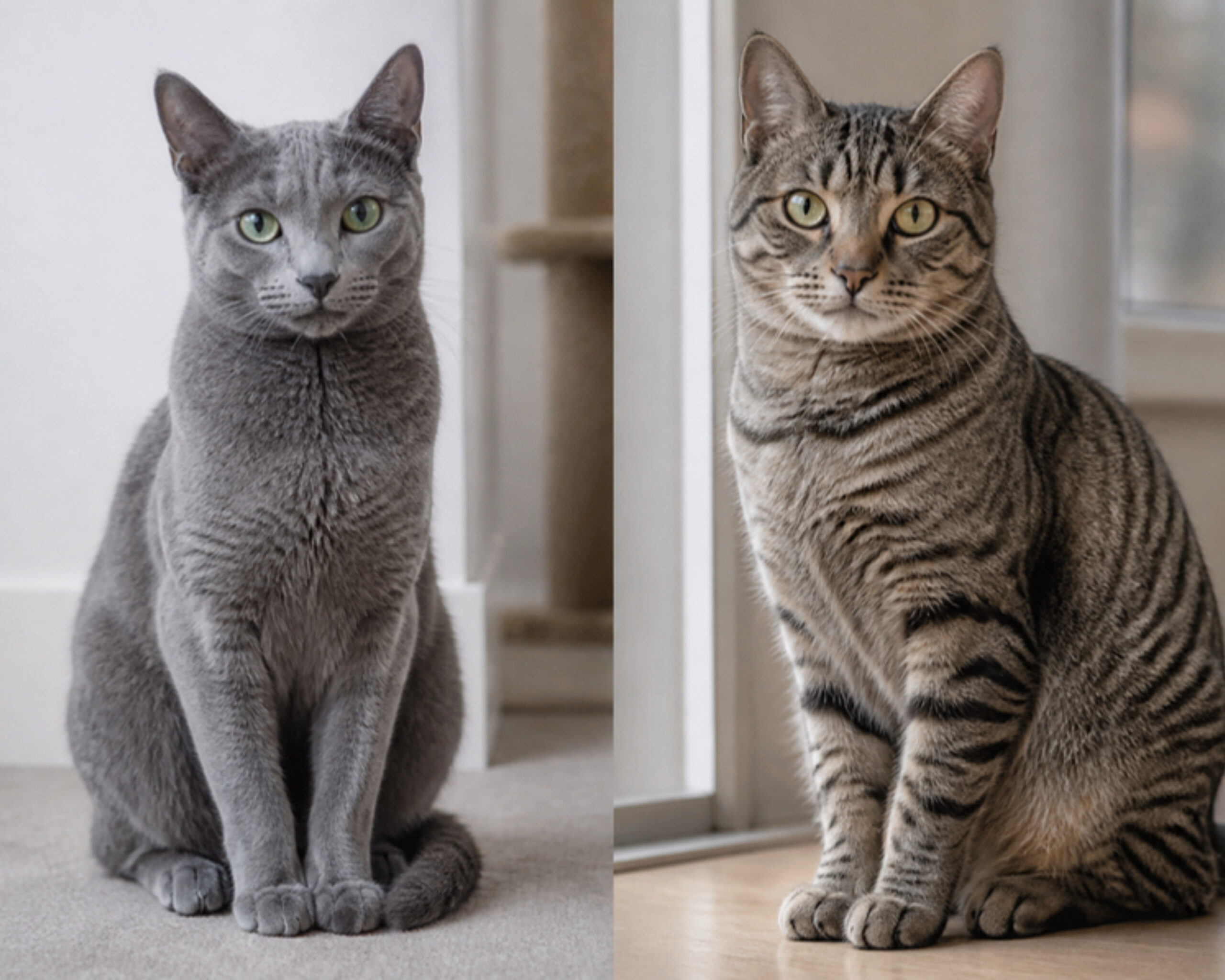
- Solid grey (blue): An even blue-grey color over the entire body with no visible stripes, even in bright light. This is what breeds like the Russian Blue and Chartreux are bred for.
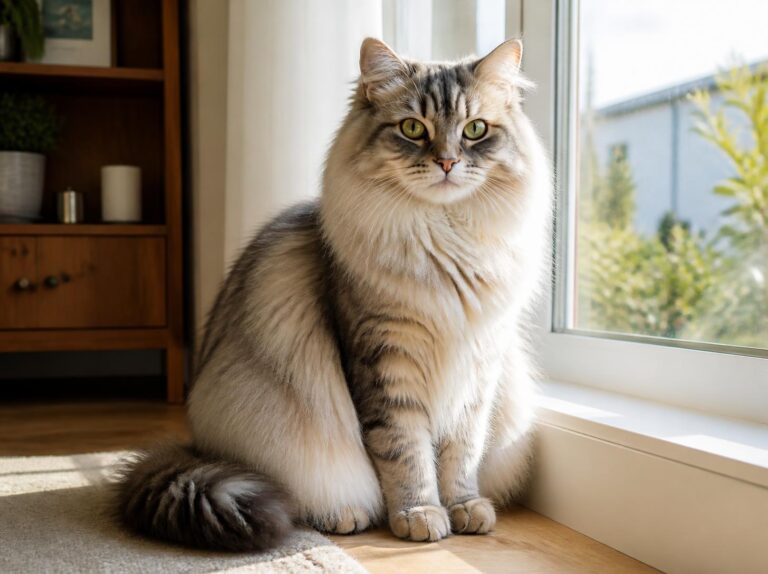
- Grey tabby: Darker charcoal-grey stripes, spots, or swirls over a lighter silver-grey background, plus the tabby “M” marking on the forehead. Most grey cats you see wandering outdoors are actually grey tabbies, not solid grey.
Cat Breeds That Are Naturally Grey
A handful of breeds are grey (blue) by default, meaning nearly every member of the breed is born that color rather than it being one option among many:
- Russian Blue: A dense, plush double coat of solid silvery-blue, with bright green eyes. One of the most recognizable “all-grey” breeds. See our full cat breeds list for more on fluffy and grey breed options.
- Chartreux: A French breed with a woolly blue-grey coat and a round, smiling face.
- Korat: A rare Thai breed with a short, single blue coat and heart-shaped face.
- British Shorthair (blue variety): The “British Blue” is the most iconic coloring for this round, dense-coated breed, though British Shorthairs come in many other colors too.
- Nebelung: A long-haired cousin of the Russian Blue, with the same silvery-blue coat in a plush, semi-long length.
Personality & Temperament
Because “grey cat” spans so many breeds and random-bred domestic cats, there’s no single grey-cat personality — temperament depends far more on breed and individual upbringing than on coat color. That said, several of the classic grey breeds share a reputation for being quiet and reserved: Russian Blues and Korats are often described as shy with strangers but deeply bonded to their own household, while British Shorthairs tend to be easygoing and low-key. A grey domestic shorthair or longhair will simply take after its own mixed background.
Grooming & Shedding
Most naturally grey breeds have dense double coats (Russian Blue, Chartreux, British Shorthair) that shed moderately year-round with heavier seasonal blowouts in spring and fall. A weekly brush with a deshedding tool keeps loose undercoat from building up and matting. Long-haired grey cats like the Nebelung need slightly more frequent brushing to prevent tangles around the legs and belly.

Health & Lifespan
Grey/blue coat color itself carries no known health risk — it’s purely cosmetic dilution of pigment, unlike white coat color, which can sometimes be linked to deafness. Health outlook instead depends on the specific breed: Russian Blues and Chartreux are both generally considered healthy, long-lived breeds (14–17 years for Russian Blue, 12–15 for Chartreux), while British Shorthairs can be prone to obesity and should have their weight monitored closely. For general feline health guidance by life stage, see our cat health hub.
Diet & Nutrition Needs
Diet needs track breed and body type rather than coat color. The stockier grey breeds like the British Shorthair and Chartreux can gain weight easily and do best on a measured, portion-controlled diet rather than free-feeding. See our cat food reviews for options suited to indoor, less-active cats.
How Much Does a Grey Cat Cost?
Cost varies enormously depending on whether you want a specific grey breed or simply a grey-colored cat. A grey domestic shorthair or longhair from a shelter typically costs $0–$150 in adoption fees. A purebred Russian Blue or Chartreux kitten from a reputable breeder runs roughly $1,000–$2,000+, while a British Shorthair in the blue color typically costs $1,000–$1,800.
Russian Blue vs. Chartreux vs. Korat vs. British Shorthair
These four breeds are the ones most often confused with each other since they’re all predominantly grey/blue:
| Breed | Coat | Build | Distinct Feature |
|---|---|---|---|
| Russian Blue | Short, dense double coat | Fine-boned, slender | Bright green eyes, “smiling” mouth |
| Chartreux | Short, woolly double coat | Sturdy, muscular | Copper-to-gold eyes, round “smiling” face |
| Korat | Short, single coat (no undercoat) | Semi-cobby, muscular | Heart-shaped face, luminous green eyes |
| British Shorthair (Blue) | Short, plush double coat | Stocky, round “teddy bear” shape | Round face and eyes, calm demeanor |
In short: the Russian Blue is the slender, elegant option; the Chartreux and British Shorthair are both sturdier and rounder-faced but the Chartreux is leaner; and the Korat is the rarest of the four and the only one with a true single-layer coat.
Is a Grey Cat Right for You?
If you’re drawn to the look rather than a specific breed, a grey domestic shorthair or longhair from a shelter is an easy, affordable way to get that coloring with no breed-specific health considerations to research. If you want the guaranteed look plus a predictable temperament and build, a purebred option like the Russian Blue (quiet, elegant) or British Shorthair (calm, sturdy) is worth the higher price tag and the wait for a reputable breeder.
Frequently Asked Questions
Is a grey cat the same as a Russian Blue?
No. “Grey cat” describes a coat color that appears in many breeds and in mixed-breed cats, while Russian Blue is one specific breed that happens to always be grey. Not every grey cat is a Russian Blue, though every purebred Russian Blue is grey.
Are grey cats rare?
Solid grey (no tabby pattern) is less common than grey tabby among random-bred cats, since it requires two copies of the recessive dilute gene. Grey tabbies, by contrast, are one of the most common coat types seen in shelters and on the street.
Do grey kittens change color as they grow?
Most grey kittens are born already showing their grey/blue color, though the shade can deepen or lighten slightly in the first year as the adult coat comes in. Unlike pointed breeds, there’s no dramatic color-development process for solid grey or grey tabby cats.