We independently research every product we recommend, drawing on real owner reviews, product specs, and vet-reviewed sources. If you buy through a link on this page, we may earn an affiliate commission at no extra cost to you.
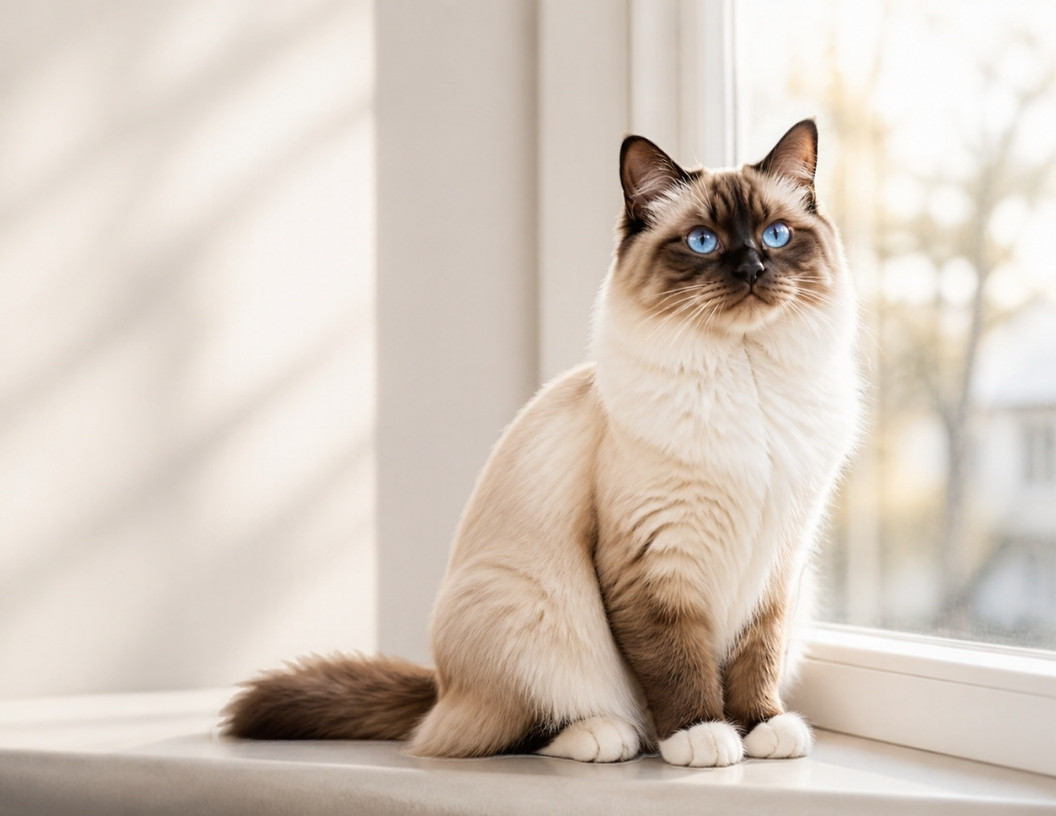
The Birman cat is easy to spot once you know the trick: deep blue eyes, a soft color-point coat, and four paws that look like they were dipped in white paint. Nicknamed the “Sacred Cat of Burma,” the Birman pairs a Persian-like gentleness with a coat that needs far less upkeep than it looks like it should. Here’s what actually sets the breed apart, what it costs, and how to tell it apart from the cats it’s most often confused with.
Table of Contents
Birman Cat Overview
| Weight | 6–12 lbs (males larger than females) |
| Coat | Semi-long, silky, single coat with a color-point pattern and white “gloved” paws |
| Lifespan | 12–16 years |
| Temperament | Gentle, affectionate, moderately active, sociable without being demanding |
| Shedding | Moderate — a single coat with little undercoat, so less matting than Persians |
| Price | $800–$2,000+ from a reputable breeder; lower for adoption |
Origin & History
The Birman’s origin story leans heavily on legend: temple cats in Burma (now Myanmar) said to have guarded golden statues of a blue-eyed goddess, their coats turning white at the paws where they touched a loyal priest. The documented history is less mystical — the breed as we know it today was developed in France in the early 20th century, where it was first recognized as a distinct breed in 1925. The Cat Fanciers’ Association (CFA) recognized the Birman in 1967, and it’s recognized by essentially every major registry today, including TICA.
Appearance & Size
Birmans are medium-to-large cats with a sturdy, rounded body, a broad head, and deep blue eyes that stay blue for life — unlike some other pointed breeds, Birman eye color doesn’t fade with age. The coat comes in the same color-point pattern seen in Siamese cats (seal, blue, chocolate, lilac, and more), but the signature feature is the white “gloves” on all four paws, ideally symmetrical and stopping at a consistent point on each leg. The coat itself is semi-long and silky with minimal undercoat, which is part of why it doesn’t mat as readily as a Persian’s.
Personality & Temperament
Birmans have a reputation as one of the gentlest, most easygoing breeds out there. They’re sociable and like being near their people without being as vocal or demanding as a Siamese, and they tend to get along well with children, other cats, and even dogs. They’re moderately playful — not a high-energy breed that needs constant stimulation, but not a couch ornament either, and most Birmans enjoy a daily play session as much as a lap to curl up on.
Grooming & Shedding
Despite the long, luxurious-looking coat, Birmans are relatively low-maintenance to groom. Because they lack the dense undercoat of a Persian, their fur doesn’t mat as easily, and a thorough brushing once or twice a week is usually enough to keep it smooth and prevent loose hair from building up around the house. Shedding picks up during seasonal coat changes in spring and fall, when more frequent brushing helps.

Health & Lifespan
Birmans are generally considered a healthy breed with a typical lifespan of 12–16 years and no single condition specific to the breed the way some others have. Like most purebred cats, they can be prone to hypertrophic cardiomyopathy (a thickening of the heart muscle), so reputable breeders typically screen breeding cats for it. Routine checkups and keeping an eye on general signs of illness go a long way — see our cat health hub for broader guidance by life stage.
Diet & Nutrition Needs
Birmans don’t have unusual dietary requirements — a high-quality food appropriate for their age and activity level covers their needs. Since they’re a moderately built breed rather than an especially lean or stocky one, portion control matters more than any special formula; a measured feeding routine helps prevent the gradual weight gain that affects a lot of indoor cats. See our cat food reviews for options across life stages.


How Much Does a Birman Cat Cost?
A Birman kitten from a reputable breeder typically runs $800–$2,000 or more, depending on pedigree, coat color, and breeder reputation — show-quality kittens with especially symmetrical gloves can command the higher end of that range. Birman-specific rescues and breed clubs occasionally have adult cats available for adoption at a fraction of that cost, usually in the $50–$300 range, though availability varies since the breed isn’t as commonly surrendered as mixed breeds.
Birman vs. Ragdoll vs. Siamese vs. Himalayan
These four breeds get mixed up constantly since they all share blue eyes, pointed coloring, or both:
| Breed | Coat | Build | Distinct Feature |
|---|---|---|---|
| Birman | Semi-long, silky, minimal undercoat | Medium-large, sturdy | White “gloves” on all four paws |
| Ragdoll | Semi-long, plush, more undercoat | Large, floppy when held | Goes limp when picked up (“flops”) |
| Siamese | Short, fine, single coat | Slender, fine-boned | Vocal, no white gloves, angular face |
| Himalayan | Very long, dense, heavy undercoat | Stocky, Persian-type body | Flat (“brachycephalic”) face |
In short: the Birman is the moderate option in almost every way — a mid-length coat that’s easier to maintain than a Ragdoll’s or Himalayan’s, a calmer voice than a Siamese, and white gloves that no other breed on this list has.
Is a Birman Cat Right for You?
A Birman is a strong fit if you want the look of a long-haired cat without a Persian’s grooming demands, and a temperament that’s affectionate without being clingy or vocal. It’s less of a fit if you’re specifically looking for a hypoallergenic cat or a highly active, independent breed — Birmans do best with regular company and moderate daily interaction rather than being left alone for long stretches.
Frequently Asked Questions
Are Birman cats the same as Ragdolls?
No, though they’re commonly confused. Ragdolls are a separate, larger breed known for going limp when picked up, with a plusher coat and more undercoat than the Birman’s silkier, lower-shed coat. The clearest tell is the Birman’s white gloves, which Ragdolls don’t have.
Are Birman cats hypoallergenic?
No cat breed is truly hypoallergenic, and the Birman isn’t one of the breeds commonly cited as lower-allergen. Allergy sufferers considering a Birman should spend time around one before committing, since individual reactions vary widely.
Why do Birman cats have white paws?
The white “gloves” come from a specific gene that affects pigmentation only at the paws, distinct from the gene responsible for the color-point pattern elsewhere on the body. Breed standards call for the gloves to be symmetrical across all four paws, which is one of the traits judges look at closely in the show ring.