We independently research every product we recommend, drawing on real owner reviews, product specs, and vet-reviewed sources. If you buy through a link on this page, Catverdict may earn a small commission — this never affects our picks or costs you anything extra. Details in our affiliate disclosure
The Savannah cat is one of the largest and most athletic domestic cat breeds you can own — a cross between a domestic cat and the African serval, prized for its tall, leggy build, wild-looking spots, and dog-like personality. But Savannahs also come with real complications most breeds don’t: huge price swings by generation, legal restrictions in several states, and exercise needs that catch new owners off guard. Here’s a complete breakdown of what to expect.
Table of Contents
Savannah Cat Breed Overview
| Weight | 12–25 lbs (early generations can exceed 20–30 lbs) |
| Coat | Short, dense, spotted — resembles wild serval markings |
| Lifespan | 12–20 years |
| Temperament | Highly energetic, dog-like, bold, intelligent |
| Shedding | Low to moderate |
| Price | $1,000–$20,000+ depending on generation |
Origin & History
The Savannah cat was first created in 1986 by crossing a male African serval with a domestic cat, with breeder Judee Frank producing one of the earliest documented litters. Patrick Kelley and Joyce Sroufe later developed the official breed standard and submitted it to The International Cat Association (TICA) in the mid-1990s. TICA accepted the Savannah for registration in 2001 and granted it full championship status in 2012, making it one of the newer breeds recognized by a major registry.
Savannahs are classified by “filial generation” — F1 through F5 and beyond — which tracks how many generations removed a cat is from its serval ancestor. An F1 has a serval parent and carries roughly 50% serval genetics, while an F5 is five generations removed and much closer to a typical domestic cat in both size and temperament. This generation number — essentially how much serval genetics a cat carries — is the single biggest factor in a Savannah’s size, price, and legality.
Appearance & Size
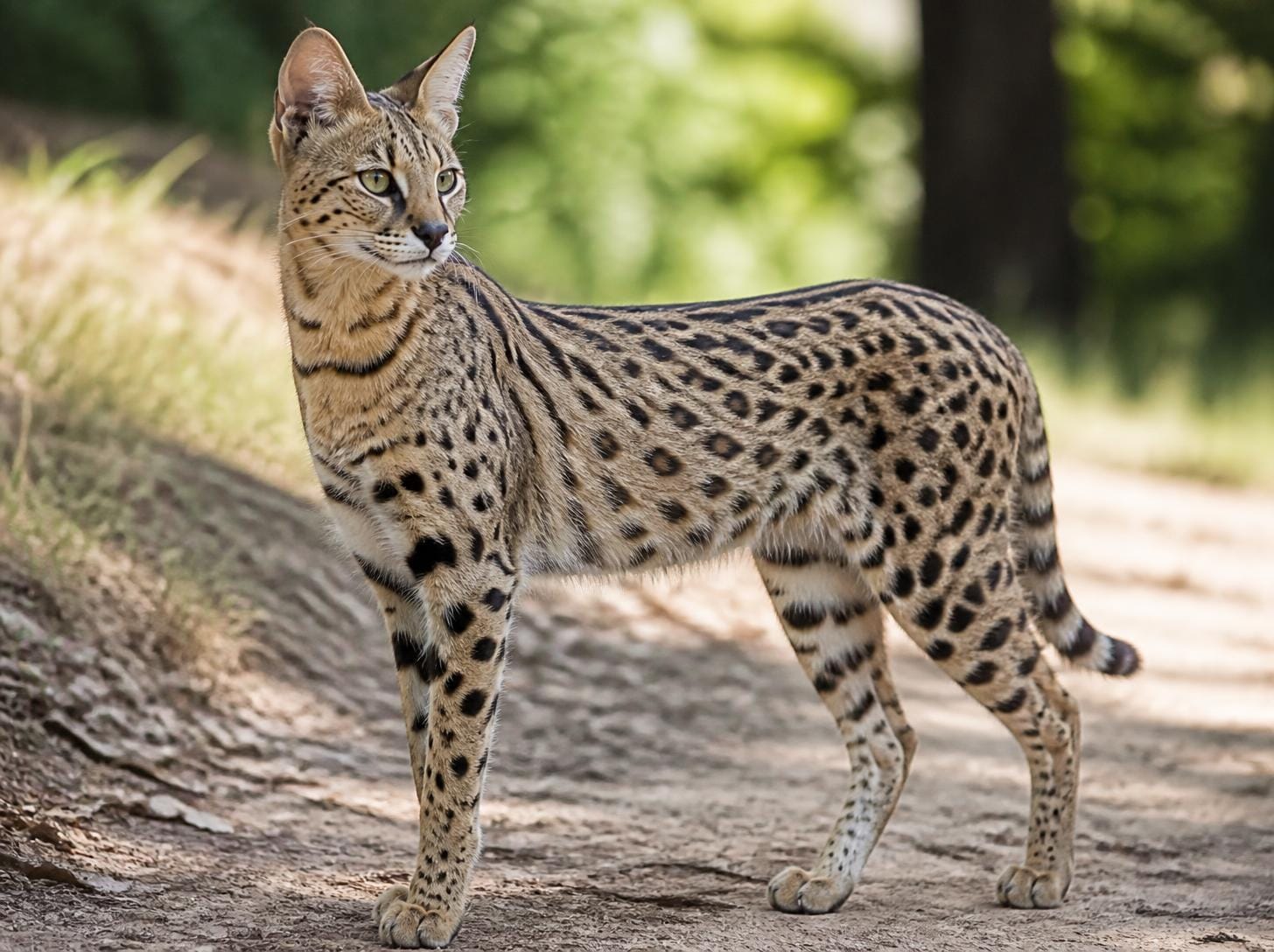
Savannahs are tall, lean, and long-legged, often cited as one of the tallest domestic cat breeds — some early-generation males stand 14–17 inches at the shoulder. Early generations (F1–F2) are the largest, with males sometimes reaching 20–25 lbs and occasionally more; later generations (F4 and beyond) typically settle between 10–17 lbs, closer to a large domestic cat.
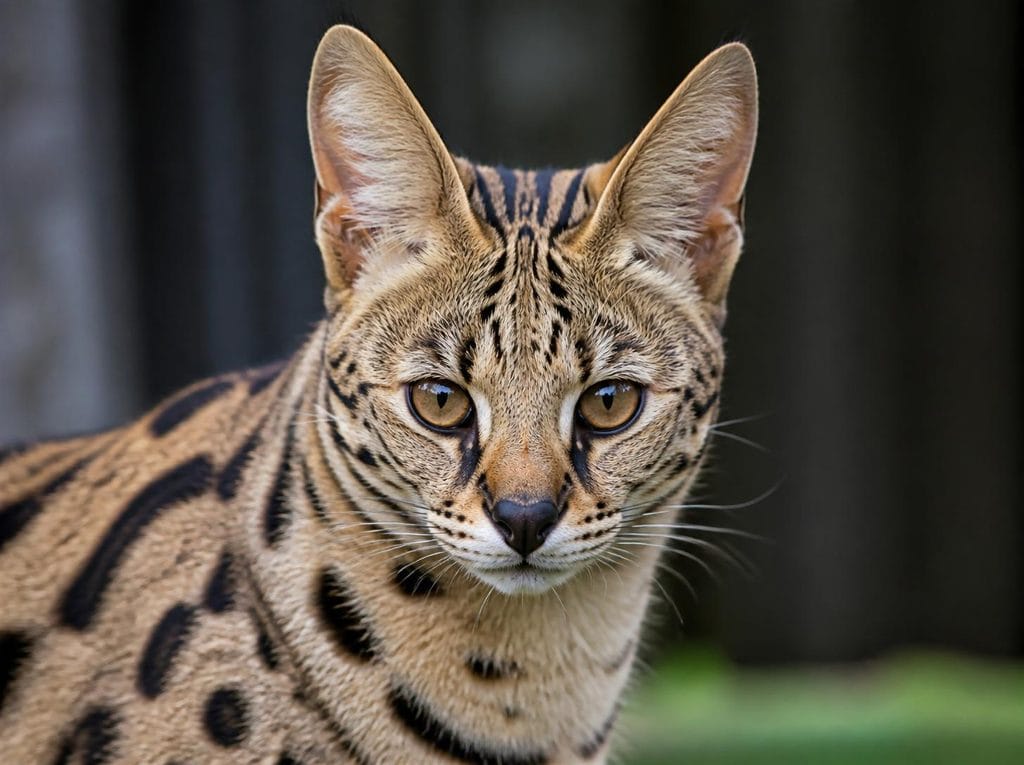
Their short, dense coat carries bold spotted markings that echo their serval ancestor — brown spotted tabby and silver spotted tabby are the most recognized colors, with black and black smoke also accepted. Large, upright ears and a slightly hooded brow add to the wild-cat look that makes Savannahs instantly recognizable.
Personality & Temperament
Savannahs are famous for dog-like behavior: many can be leash-trained, learn to fetch, and greet their owners at the door. They’re highly intelligent, strongly food- and prey-motivated, and known for jumping to impressive heights — a Savannah on top of a refrigerator or tall bookshelf isn’t unusual. Many also enjoy water, sometimes joining owners in the shower or playing in a sink.
Earlier generations (F1–F2) tend to bond intensely with one person and can be more reserved with strangers, while later generations (F4–F5+) are generally more easygoing and social with the whole household. Across all generations, Savannahs need daily physical and mental enrichment — interactive toys, climbing space, and play sessions are not optional for this breed.
Savannahs — like several other hybrid breeds — are also more prone than average to pica, a tendency to chew or ingest non-food items such as fabric, foam, or plastic, often linked to boredom or high energy that hasn’t been burned off. Offering plenty of safe chew toys and supervised play can help manage it, and persistent pica is worth mentioning to your vet to rule out other causes.


Savannahs rely on vertical territory to patrol, climb, and feel secure, so a tall cat tree or wall shelving system is almost essential for this breed — see our guide to cat toys and gear for options built to handle an active climber.
Grooming & Shedding
Thanks to their short, dense coat, Savannahs are relatively low-maintenance to groom — weekly brushing is usually enough to control shedding and keep the coat glossy. They don’t have the seasonal “blowouts” that longer-haired breeds do, though regular brushing still helps reduce loose hair around the house and cuts down on hairballs.

- 【GENTLE GROOMING & MASSAGE】 Turn everyday petting into a relaxing grooming routine with the DELOMO pet hair removal glov…
- 【REMOVE LOOSE FUR BEFORE IT SPREADS】 Designed to collect shedding hair directly from your pet’s coat, this cat brush glo…
- 【FLEXIBLE 5-FINGER DESIGN】 Unlike traditional grooming brushes, this pet grooming glove moves naturally with your hand. …
Health & Lifespan
The Savannah cat is generally considered a hardy breed, with many owners and breeders pointing to hybrid vigor from the serval lineage. Reported lifespans run 12–20 years, and there are no widely documented breed-specific inherited diseases the way there are in some older breeds. Early-generation (F1–F2) kittens can have more sensitive digestive systems as kittens, so a careful, breeder-guided food transition matters. Routine vet checkups and weight management apply here just as they do for any breed — see our complete guide to cat health care for preventive basics.
Diet & Nutrition Needs
Given their athletic build and high activity level, Savannahs do best on a high-protein diet that supports lean muscle rather than a filler-heavy formula. Some owners of early-generation Savannahs lean toward raw or high-meat-content diets because of the breed’s wild ancestry, though a quality high-protein commercial food is suitable for most Savannahs — check with your vet or breeder for generation-specific advice. Our best cat food guide breaks down high-protein picks across wet and dry formats.



- Premium 304 Stainless Steel & Easy Maintenance. Crafted from high-quality 304 stainless steel, this pet fountain offers …
- Quick Snap-Together Assembly & Large Water Window. Set up in minutes with the intuitive four-step, snap-together design….
- Ultra-Quiet Suspended Pump Design. The advanced suspended pump operates at a whisper-quiet 25 dB, ensuring peaceful oper…
How Much Does a Savannah Cat Cost?
Price varies more by generation than almost any other factor. Expect to pay roughly $10,000–$20,000+ for an F1 Savannah, $5,000–$10,000 for an F2, $2,500–$5,000 for an F3, and $1,000–$3,000 for F4 and later generations, which are the most commonly available and most affordable. Reputable breeders should provide TICA pedigree paperwork documenting the generation — this matters for both price verification and, in some places, legal compliance.
Is It Legal to Own a Savannah Cat?
Because of their wild serval ancestry, Savannah cats are regulated or restricted in a number of U.S. states and cities, and the rules depend heavily on filial generation — earlier generations (F1–F3) face the most restrictions, while later generations (typically F4/F5 and beyond) are often treated as ordinary domestic cats. As of 2026, the rules commonly break down like this:
- Banned outright (all generations): Georgia, Hawaii, Nebraska, Rhode Island
- Restricted to later generations only (commonly F4 or F5 and later): Alaska, Colorado, Massachusetts, New Hampshire, New York State, Vermont
- City-level bans on top of state law: New York City and Denver ban Savannahs even in states that allow later generations
Before buying, check your state’s exotic/hybrid animal statutes and your local city or county ordinances, and ask the breeder for documented proof of generation (a TICA pedigree). This isn’t a one-time check — rules vary block by block in some areas and are updated periodically, so verify current law with your state wildlife or agriculture agency rather than relying on older articles.
Savannah vs. Bengal vs. Ocicat
Savannahs are often confused with other spotted breeds that also carry wildcat-like markings — though only the Savannah traces its genetics directly to a serval. Here’s how the three compare:
| Breed | Weight | Coat Pattern | Energy Level | Avg. Price |
|---|---|---|---|---|
| Savannah | 12–25 lbs | Spotted, serval-like | Very high | $1,000–$20,000+ |
| Bengal | 8–15 lbs | Spotted or marbled, wild-looking | High | $1,000–$5,000+ |
| Ocicat | 9–15 lbs | Spotted, fully domestic — no wild ancestry | Moderate–high | $800–$1,500 |
In short: Bengals have serval-like spots too but come from an Asian leopard cat cross and are smaller and more widely legal; Ocicats look spotted but have no wild ancestry at all, making them the simplest option legally and often the most budget-friendly.
Is a Savannah Cat Right for You?
A Savannah cat suits an experienced owner who can commit to daily active play, vertical space for climbing, and — depending on generation — a significant budget. They’re a poor fit for anyone wanting a low-energy lap cat, a small living space with no climbing options, or anyone who hasn’t confirmed local legality first. If that sounds like a lot of commitment, a Bengal or Ocicat may scratch a similar itch with fewer restrictions.
Frequently Asked Questions
What do the Savannah generations (F1–F5) mean?
The filial number shows how many generations a cat is removed from its serval ancestor — F1 has a serval parent and the most wild traits, while F5+ is several generations removed and closest in size and temperament to a typical domestic cat.
How big do Savannah cats get?
Early-generation males (F1–F2) can reach 20–25 lbs or more, while later generations (F4+) typically weigh 10–17 lbs, comparable to a large domestic cat.
Are Savannah cats legal to own in the US?
It depends on your state, city, and the cat’s generation. Georgia, Hawaii, Nebraska, and Rhode Island ban Savannah cats outright at every generation, several other states (including Alaska, Colorado, Massachusetts, New Hampshire, and Vermont) only allow later generations, and cities like New York City and Denver add their own bans on top of state law. Always confirm current rules with your local and state authorities before buying.
Do Savannah cats need a lot of exercise?
Yes — Savannahs are one of the most energetic domestic cat breeds and need daily interactive play and climbing opportunities to stay happy and avoid destructive behavior.