We independently research every product we recommend, drawing on real owner reviews, product specs, and vet-reviewed sources. If you buy through a link on this page, we may earn an affiliate commission at no extra cost to you.
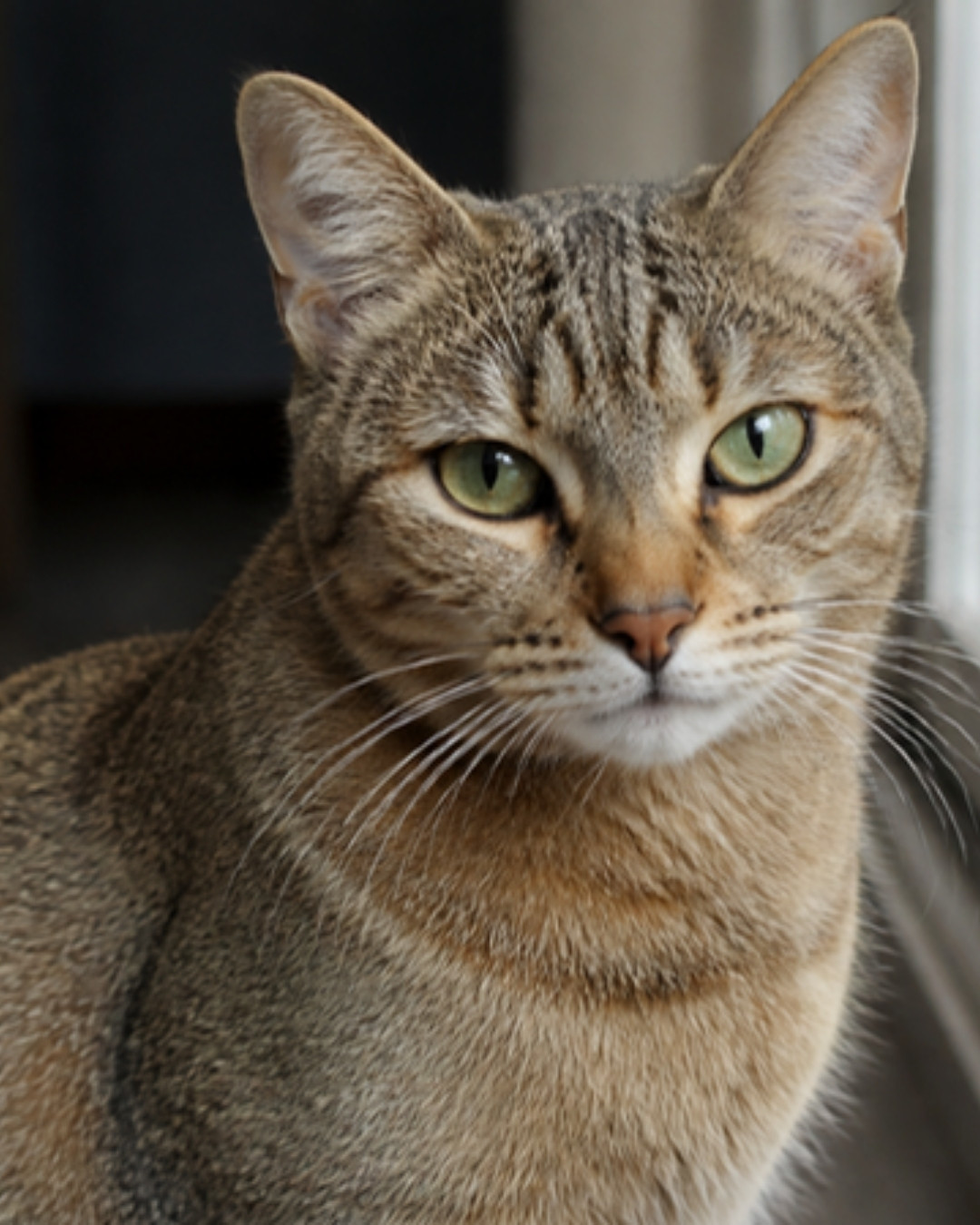
A ticked tabby is the one tabby pattern that doesn’t actually show stripes, spots, or swirls — instead, each individual hair is banded with alternating light and dark color, giving the coat an overall salt-and-pepper, “agouti” look. It’s the signature coat of the Abyssinian, but it shows up in several other breeds and in plenty of random-bred domestic cats too. Here’s what makes a tabby “ticked,” which breeds carry it, and how to tell it apart from the other tabby patterns.
Table of Contents
Ticked Tabby Overview
| Pattern Name | Ticked (agouti) tabby — no visible stripes, spots, or swirls on the body |
| Caused By | The dominant Abyssinian tabby allele (Ta), which suppresses patterning on the body |
| Signature Breed | Abyssinian |
| Also Common In | Singapura, Somali, Sokoke, and plenty of domestic shorthairs/longhairs |
| Lifespan | 12–18 years (varies by breed) |
| Typical Price | $0–$150 (shelter, random-bred) to $800–$2,000+ (purebred, e.g. Abyssinian) |
What Makes a Tabby “Ticked”? (The Genetics)
Every tabby cat carries the agouti gene, which bands each individual hair with alternating stretches of light and dark pigment rather than coloring it a single solid shade — this banding is what gives any tabby coat its depth and texture. Which visible pattern shows up on top of that banding (classic swirls, mackerel stripes, spots, or ticking) is controlled by a separate gene. The ticked variant, caused by the dominant Abyssinian allele (Ta), suppresses the stripes and spots almost entirely on the body, leaving mostly the agouti banding visible — though faint “ghost” markings often remain on the face, legs, and tail tip.
Ticked Tabby vs. Other Tabby Patterns
There are four recognized tabby patterns, and ticked is the subtlest of the group:
| Pattern | What It Looks Like |
|---|---|
| Ticked | No body stripes or spots — an overall peppery, banded look with ghost markings only on face/legs/tail |
| Classic (blotched) | Bold, swirling “bullseye” patches on the sides |
| Mackerel | Narrow, parallel vertical stripes down the sides, like a fish skeleton |
| Spotted | Stripes broken up into distinct spots |
All four patterns share the same tabby “M” marking on the forehead and the same agouti hair banding — ticked just hides the body pattern most effectively.
Cat Breeds Known for Ticked Tabby Coats
A handful of breeds are ticked tabby by default or near-default:
- Abyssinian: The breed most associated with the ticked pattern — a warm, reddish-brown agouti coat is the hallmark of the breed. See our full cat breeds list for more breed profiles.
- Somali: Essentially a long-haired Abyssinian, with the same ticked coat in a fuller, fox-like length.
- Singapura: One of the smallest cat breeds, with a fine ticked coat in warm sepia tones.
- Sokoke: A rare African-origin breed with a naturally occurring ticked/blotched “wood-grain” pattern.
- Domestic shorthair/longhair: Ticked tabby turns up fairly often in mixed-breed and shelter cats too, independent of any specific breed.
Personality & Temperament
Since ticked tabby is a coat pattern rather than a breed, there’s no single personality tied to it — temperament depends on the specific breed or the individual cat. That said, the breeds most associated with ticking tend to be active and people-oriented: Abyssinians and Somalis are famously energetic, curious, and borderline dog-like in how closely they follow their owners, while Singapuras are typically described as affectionate and inquisitive despite their small size. A random-bred ticked tabby will simply take after its own background.
Grooming & Shedding
Short-coated ticked tabbies (Abyssinian, Singapura, most domestic shorthairs) are low-maintenance, needing only an occasional brush to remove loose hair. The Somali’s longer coat sheds more noticeably and benefits from weekly brushing with a deshedding tool to prevent matting, especially around the britches and tail.

Health & Lifespan
The ticked tabby pattern itself carries no known health implications — it’s purely cosmetic. Health outlook instead depends on the breed: Abyssinians and Somalis are generally healthy with a 12–16 year lifespan but can be prone to a hereditary kidney condition (PKD) and a retinal condition, so reputable breeders screen for both. Singapuras are typically long-lived and robust. For general feline health guidance by life stage, see our cat health hub.
Diet & Nutrition Needs
Diet needs track the individual breed rather than the coat pattern. The naturally lean, athletic breeds in this group (Abyssinian, Somali, Singapura) tend to do well on a protein-rich diet that supports their higher activity level rather than a weight-management formula. See our cat food reviews for options across life stages.
How Much Does a Ticked Tabby Cat Cost?
Cost depends entirely on whether you want a specific ticked-tabby breed or simply the look. A ticked tabby domestic shorthair from a shelter typically costs $0–$150 in adoption fees. A purebred Abyssinian or Somali kitten from a reputable breeder usually runs $800–$1,500+, while the rarer Singapura and Sokoke can run $1,500–$2,500 or more due to limited breeding populations.
Abyssinian vs. Singapura vs. Somali vs. Domestic Ticked Tabby
These are the ticked tabby cats people most often cross-shop or confuse:
| Breed | Coat Length | Size | Distinct Feature |
|---|---|---|---|
| Abyssinian | Short | Medium | Warm reddish ticking, large alert ears |
| Somali | Long | Medium | Same ticking as the Abyssinian in a fuller, fox-like coat |
| Singapura | Short | Very small | Smallest cat breed, large eyes, sepia ticking |
| Domestic Ticked Tabby | Varies | Varies | No guaranteed look or temperament — depends on the individual cat |
In short: the Abyssinian is the classic, medium-energy ticked breed; the Somali is its long-haired twin; the Singapura is the tiny, people-focused option; and a domestic ticked tabby from a shelter gets you the look at a fraction of the cost, with less predictability on size and temperament.
Is a Ticked Tabby Right for You?
If you just like the agouti look, a ticked tabby domestic shorthair from a shelter is the easiest and most affordable route, with no breed-specific health screening to worry about. If you want the guaranteed look plus a specific, well-documented temperament — high-energy and people-oriented with the Abyssinian or Somali, or small and social with the Singapura — a purebred option is worth the higher price and the wait for a reputable breeder.
Frequently Asked Questions
Is a ticked tabby the same as an Abyssinian?
No. “Ticked tabby” describes a coat pattern that appears in several breeds and in mixed-breed cats, while Abyssinian is one specific breed that’s famous for carrying it. Every purebred Abyssinian is a ticked tabby, but not every ticked tabby is an Abyssinian.
Are ticked tabby cats rare?
The ticked pattern is less common than classic or mackerel tabby markings among random-bred cats, since it depends on the dominant Abyssinian tabby allele being present. It’s still far from rare, though — it shows up regularly in shelters and in several well-established breeds.
Can a ticked tabby cat have stripes anywhere?
Yes — most ticked tabbies still show faint “ghost” striping on the face, legs, and tail tip even though the body itself looks solid-colored at a glance. These markings are usually more visible on kittens and fade somewhat as the cat matures.